
An easy-to-understand guide for patients.
Low back pain and hip pain often turn up together. Some people get an ache in the lower back after their hip becomes stiff. Others feel pain in the buttock or hip that actually comes from the lower back. Often, both areas play a part.
To understand why, it helps to look beyond the sore spot. Your lower back, pelvis and hips work as one team to carry your weight, absorb forces and let you walk, bend, lift and turn. A change in one area can affect how the others work.
But being linked is not the same as being the cause. A stiff hip, weaker muscles or an unusual way of moving may be relevant to your pain, yet none of these on its own proves why the pain started.
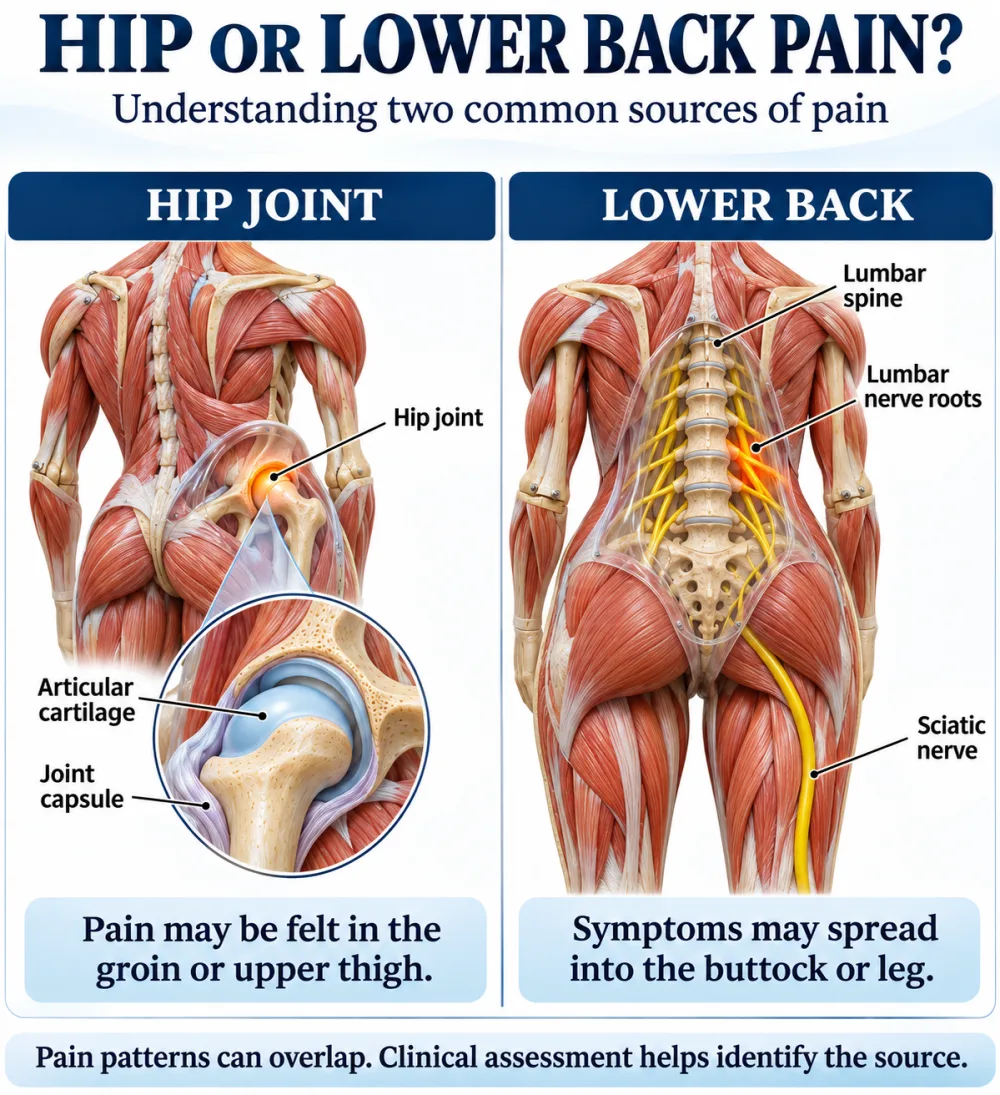
How the Lower Back, Pelvis and Hips Work Together
The lumbar spine is the five bones of your lower back, along with their discs, joints, ligaments and muscles. Below it, the sacrum joins the pelvis at the sacroiliac joints. Each hip is a ball-and-socket joint: the ball at the top of the thigh bone (femoral head) sits in a socket in the pelvis (acetabulum).
These areas share the work in everyday movement:
- Bending down: the hips bend, the pelvis tips forward and the lower back usually bends a little too. This teamwork is called lumbopelvic rhythm. How much each part contributes depends on the task, your body shape, your mobility and the load.
- Walking: the hips swing forward and back while the pelvis and trunk make smaller matching movements.
- Standing on one leg: the muscles around the hip and trunk keep the pelvis level and your body balanced.
There is no single "perfect" way to move. The useful question is whether you can do what you need to do comfortably, with enough movement, strength and stamina.
How a Stiff Hip Can Affect Your Lower Back
If a hip doesn't move well, the body often makes up for it somewhere else. For example:
- Limited hip bending may mean you bend more through your lower back when reaching down.
- Limited hip extension (moving the leg behind you) may shorten your stride or add extra pelvic and trunk movement when walking.
- Limited hip rotation may change how you turn, climb stairs or get out of a car.
These workarounds are often helpful – they keep you moving despite stiffness. But if your lower back is already sensitive, repeating them can become uncomfortable, especially when you suddenly do more.
This doesn't mean bending your back is harmful or that you should keep it rigid. Bending and twisting are normal. Rehab aims to build what your body can comfortably handle, not to stop your spine from moving.
Hip arthritis is one known condition that can change the way you walk and put more demand on the lower back. Even so, treating a stiff hip won't fix every episode of back pain, especially when other factors are involved.
The Role of Hip and Trunk Muscles
Several muscle groups help the hips and lower back work together:
- Gluteus maximus – powers you up from a chair, up stairs and when running.
- Gluteus medius and minimus – keep the pelvis and thigh steady when walking or standing on one leg.
- Hip rotators and adductors – help with turning, balance and control of the thigh.
- Iliopsoas – lifts the thigh and connects to the lower spine and pelvis.
- Abdominal and back muscles – control trunk movement and respond to changing loads.
Pain can change how these muscles work. You might spend less time on a painful leg, brace your trunk harder or avoid certain movements. Over time, doing less can also reduce strength and stamina.
Labels like "lazy glutes", "a weak core" or "tight hip flexors" can oversimplify things. Weakness can be a result of pain as well as a cause. A muscle that feels tight may be guarding, rather than being permanently short.
A good rehab programme looks at what you can do, which activities set off your symptoms and how your capacity changes over time.
Hip–Spine Syndrome: When Both Areas Are Involved
Hip–spine syndrome describes hip and lower back problems that exist together or affect each other. It is a description rather than one specific diagnosis.
For example, someone might have hip osteoarthritis and lumbar spinal stenosis (narrowing in the lower spine). Both can limit walking, but they tend to cause different symptom patterns and need different management.
Sometimes one area is the main source. Sometimes both contribute, and treatment needs to address each in the right order. That's why examining only the back, or only the hip, can miss important clues.
Common Hip Conditions That Overlap With Back Pain
Hip osteoarthritis
Osteoarthritis affects the whole hip joint, including cartilage, bone and surrounding tissues. Typical signs include:
- Groin pain.
- Stiffness after sitting or resting.
- Growing difficulty with walking or daily tasks, such as putting on socks, trimming toenails or getting in and out of a car.
- Reduced hip movement, especially rotation.
Pain can also be felt in the thigh, buttock or even the knee, so it isn't always right over the hip. An X-ray can show arthritic changes, but treatment decisions depend on your symptoms and function, not the scan alone.
Greater trochanteric pain syndrome (GTPS)
GTPS causes pain on the outside of the hip, over the bony point called the greater trochanter. It usually involves the gluteus medius and minimus tendons, sometimes with an irritated bursa – so the older name "trochanteric bursitis" doesn't tell the full story.
It often hurts when lying on that side, climbing stairs, walking longer distances or standing on one leg. It can occur alongside low back pain, but shouldn't automatically be blamed on a pinched nerve.
Management usually means easing activities that squash or overload the tendons and gradually strengthening the hip muscles. Strong stretches that pull the leg across the body can make some cases worse.
Femoroacetabular impingement syndrome (FAI)
FAI syndrome involves symptoms from the ball and socket of the hip pinching against each other. It can cause groin pain with deep squats, pivoting or long periods of sitting, and sometimes stiffness or a catching feeling.
Diagnosis needs your symptoms, a clinical exam and imaging to line up. A certain bone shape on a scan does not, by itself, prove it is causing your pain.
How the Lower Back Can Cause Hip or Buttock Pain
Pain around the hip can come from the lower back in more than one way:
- Referred pain – pain from one structure is felt somewhere else. Lower back structures can cause buttock or hip pain without numbness or weakness.
- Radicular pain – an irritated spinal nerve root can cause sharp, burning or electric pain travelling down the leg, sometimes with tingling or numbness. Radiculopathy means the nerve isn't working properly, which may show up as weakness, changes in feeling or altered reflexes.
- Sciatica – pain travelling through the buttock and down the leg, sometimes into the foot.
Not every buttock ache is sciatica, and where you feel pain can't reliably tell a hip problem from a back problem on its own.
| More likely hip-related | More likely back-related | |
|---|---|---|
| Where it's often felt | Groin, upper thigh, outer hip | Lower back, buttock, down the leg |
| Typical triggers | Putting on socks, getting out of a car, deep squats, lying on the side | Certain back movements, prolonged postures |
| Possible nerve signs | Usually none | Tingling, numbness, burning or weakness in the leg |
These are general patterns only – they often overlap, and an assessment is the best way to tell.
What a Good Assessment Looks At
A useful assessment starts with your story: when it started, where you feel it, what sets it off and what settles it. The examination may then include:
- Everyday movement: walking, standing up from a chair, stepping, bending and balance.
- Hip mobility: how far the hip moves, including bending, extending and rotating.
- Lower back movement: whether certain movements bring on or change your familiar symptoms.
- Muscle performance: hip and trunk strength, endurance and control.
- Nerve checks: feeling, reflexes and strength if a nerve may be involved.
- Specific tests: chosen according to what's suspected.
Tests such as FADIR and FABER can help assess hip-related symptoms, but a positive test doesn't confirm one diagnosis. Findings need to be looked at together.
Progress is best measured by things that matter to you – walking further, sleeping more comfortably or climbing stairs with more confidence – rather than hitting a particular posture or angle.
Do You Need an X-ray or MRI?
Imaging is useful when it answers a specific question or is likely to change your treatment.
- Hip X-rays can help check for osteoarthritis or some bone problems.
- MRI or other tests may be needed when a condition can't be properly assessed by examination and X-ray alone.
- For straightforward low back pain, routine scans are generally not recommended. They may be considered if a serious problem is suspected, nerve signs need investigating, or the result would change management.
Scan results must match the clinical picture. A visible change doesn't automatically explain your pain, and a reassuring X-ray doesn't rule out every tendon, nerve or soft-tissue problem.
Rehabilitation: Building Capacity in Both Areas
Adjust activity – don't stop moving
A sudden jump in walking, running, lifting or stair climbing can exceed what your body is ready for. Easing back on the most aggravating activity for a while can help, while keeping up other movement you tolerate. The goal is a gradual return to normal activity, not long periods of rest.
Improve mobility where it matters
Gentle hip mobility work can help when stiffness limits daily life. Stretches should suit the condition, though – a pinching pain in the groin or increasing pain on the outer hip is a signal to modify the movement, not push through it.
Build strength step by step
Depending on your assessment, exercises might include supported sit-to-stands, step-ups, bridges, hip strengthening or trunk endurance work. These are examples, not a one-size-fits-all programme. Resistance, range, repetitions and frequency should match your starting point and how you respond.
Practise what matters to you
Exercise is most useful when it supports real tasks: walking to work, carrying shopping, getting out of a low chair or returning to sport. Varying tasks and gradually increasing the challenge helps rebuild confidence and function.
Hands-on care as a helper
Manual therapy or massage can ease symptoms for some people and make movement easier. For low back pain, guidelines recommend using manual therapy as part of a package that includes exercise. Hip osteoarthritis rehab may also combine education, exercise and selected hands-on techniques.
The aim is to support activity and recovery, not to rely on repeated passive treatment.
When to Seek Medical Attention
Most back and hip pain can be assessed at a routine appointment, but some symptoms need prompt attention.
Seek emergency care if you have:
- New difficulty controlling or emptying your bladder, or loss of bowel control.
- Numbness around the genitals or back passage.
- Severe or rapidly worsening leg weakness – especially with back or leg pain.
Get urgent assessment for:
- Severe hip pain after a fall, or being unable to put weight on the leg.
- A hot, painful hip with fever or feeling unwell.
Ongoing pain with unexplained weight loss, a history of cancer or other worrying changes should be discussed with your doctor.
The Bottom Line
The link between your hip and lower back is best understood by looking at your symptoms, how you move and what you do day to day. Assessing both areas helps find what's really contributing, and a personalised rehab plan can build the mobility, strength and confidence you need to get back to activity comfortably.
Struggling with hip, buttock or lower back pain? Book an assessment with our team at Midtown Wellness today.
Midtown Wellness
ACC-accredited clinic in Auckland CBD providing massage, acupuncture and physiotherapy. The hands with knowledge are powerful.