An easy-to-understand guide for patients.
Do you experience numbness, tingling or pain in your thumb, index or middle finger? Do your hands sometimes feel weak, especially when holding your phone, driving or sleeping?
These symptoms may be related to Carpal Tunnel Syndrome (CTS), but the problem does not always begin at the wrist.
The median nerve travels from your neck, through your arm and forearm, and into your hand. Understanding where this nerve becomes compressed can help guide the right treatment.
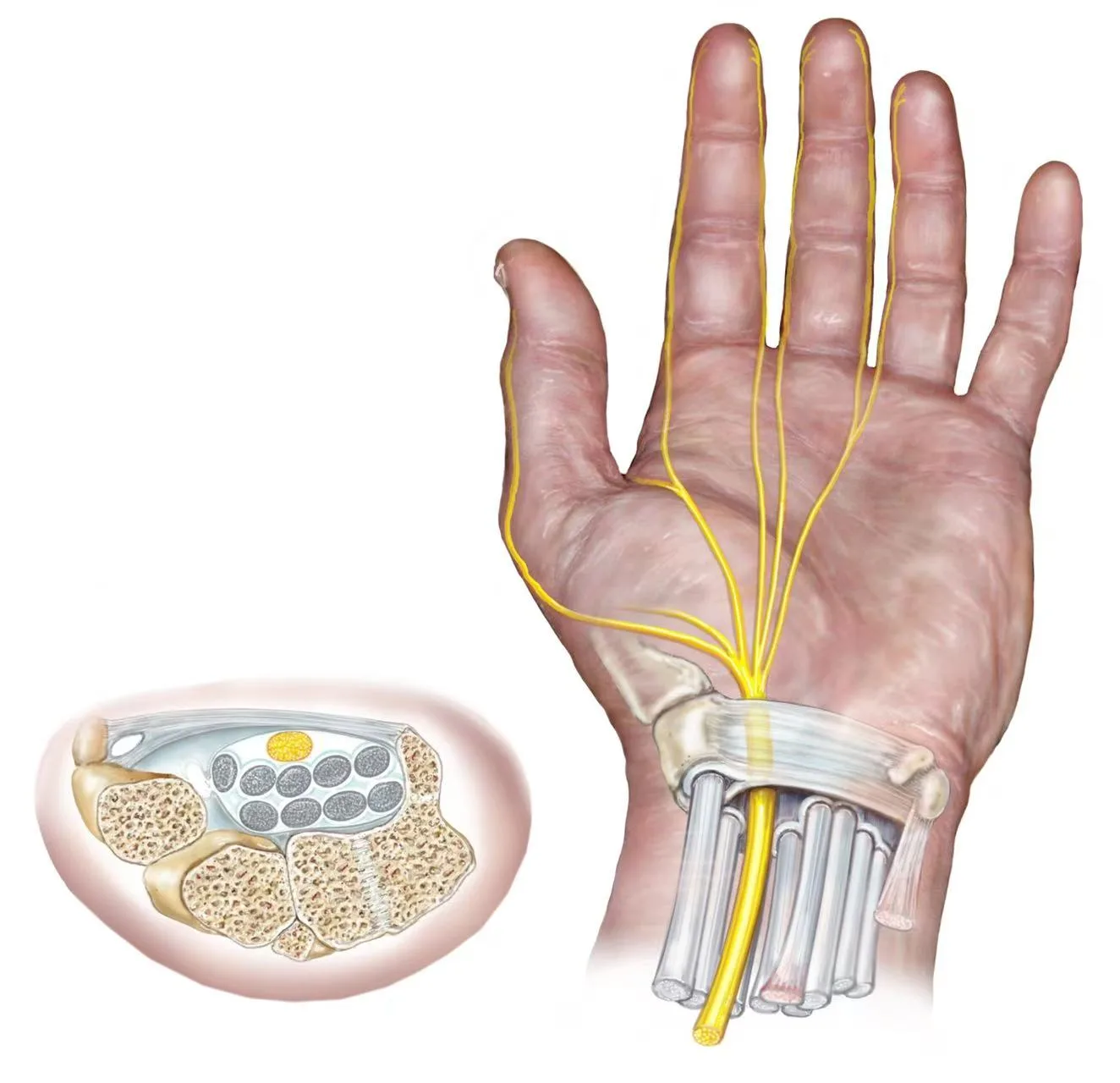
What Is Carpal Tunnel Syndrome?
Carpal Tunnel Syndrome occurs when the median nerve becomes compressed as it passes through a narrow space in the wrist called the carpal tunnel.
This tunnel contains the median nerve and nine flexor tendons that help move your fingers and thumb. When pressure increases inside the tunnel, the nerve may become irritated or compressed.
Common symptoms include:
- Numbness or tingling in the thumb, index, middle and part of the ring finger.
- Hand pain or discomfort, especially at night.
- Weak grip strength or difficulty holding small objects.
- Symptoms that become worse when the wrist stays bent for a long time.
- In more advanced cases, weakness or muscle wasting around the base of the thumb.
Many people notice that shaking their hands temporarily relieves the tingling.
Carpal Tunnel Syndrome vs. Median Nerve Entrapment
Although these terms are closely related, they do not mean exactly the same thing.
- Carpal Tunnel Syndrome refers specifically to compression of the median nerve at the wrist.
- Median Nerve Entrapment is a broader term describing compression of the median nerve anywhere along its course.
In other words, Carpal Tunnel Syndrome is one type of median nerve entrapment, but not all median nerve entrapments are Carpal Tunnel Syndrome. The median nerve may also become compressed around the elbow or within the muscles of the forearm.
This distinction is important because different compression sites may require different assessment and treatment approaches.
Where Does the Median Nerve Travel?
The median nerve originates from the brachial plexus, a network of nerves formed by nerve roots from the lower neck and upper thoracic region (C5–T1). Its pathway can be divided into four main regions.
Upper arm
The median nerve travels down the upper arm alongside the brachial artery. It normally does not supply muscles in this region.
Elbow
Near the front of the elbow, the median nerve passes beneath connective tissue associated with the biceps muscle and enters the forearm.
Forearm
The nerve travels between the two heads of the pronator teres muscle, then passes beneath the fibrous arch of the flexor digitorum superficialis muscle. Along the way, it supplies several muscles responsible for wrist and finger movement.
Wrist and hand
Finally, the median nerve travels through the carpal tunnel and enters the hand. It provides sensation to the thumb, index finger, middle finger and the thumb-side half of the ring finger, while also controlling several important thumb muscles.
Common Sites of Median Nerve Compression
A. Carpal tunnel – wrist
This is the most common site of median nerve compression. Typical symptoms include nighttime tingling, finger numbness and reduced hand strength.
B. Pronator teres – upper forearm
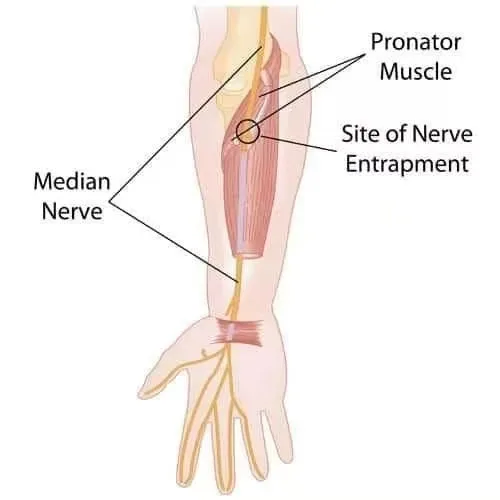
The median nerve passes between two parts of the pronator teres muscle, which helps rotate the forearm. Compression in this region is often associated with Pronator Syndrome.
Possible symptoms include aching in the forearm, tingling in the hand and discomfort during repeated forearm rotation or gripping activities. Unlike classic Carpal Tunnel Syndrome, symptoms may be more noticeable during daytime activities.
C. Lacertus fibrosus – front of the elbow
The lacertus fibrosus is a band of connective tissue extending from the biceps tendon across the front of the elbow. In some people, this structure may compress the median nerve, contributing to forearm discomfort, hand weakness or reduced grip performance.
D. Flexor digitorum superficialis arch – forearm
The median nerve passes beneath a fibrous arch associated with the flexor digitorum superficialis muscle. Compression here may produce symptoms similar to other forms of proximal median nerve entrapment.
E. Anterior interosseous nerve – forearm
The anterior interosseous nerve is a branch of the median nerve. Compression or injury affecting this branch mainly causes muscle weakness rather than skin numbness.
For example, a person may struggle to make a strong, rounded "OK" sign using the thumb and index finger.
Quick comparison
| Carpal Tunnel Syndrome | Elbow / Forearm Entrapment | |
|---|---|---|
| Where | Wrist | Front of the elbow or upper forearm |
| When it's worse | Often at night or with the wrist bent | Often during the day, with repeated forearm rotation or gripping |
| Typical signs | Tingling and numbness in the thumb and first fingers; weak grip | Forearm aching plus hand tingling; or thumb/index weakness without numbness (anterior interosseous nerve) |
How Can Physiotherapy, Acupuncture and Massage Help?
Treatment depends on the location, severity and underlying cause of nerve compression.
Physiotherapy
Physiotherapy may help by assessing wrist, elbow and upper-limb movement, improving strength, modifying aggravating activities and providing appropriate exercises.
For Carpal Tunnel Syndrome, a neutral-position wrist splint worn at night is often recommended as an early management option.
Acupuncture
Acupuncture may help some people manage pain and discomfort associated with upper-limb conditions, although evidence for lasting improvement in Carpal Tunnel Syndrome remains uncertain. It may be considered as a complementary treatment rather than a replacement for appropriate medical assessment.
Massage therapy
Gentle massage and soft tissue techniques may help reduce associated muscle tension and improve comfort in the forearm, shoulder and neck.
However, massage does not necessarily remove physical pressure on a compressed nerve. Treatment should avoid techniques that aggravate tingling, numbness or pain.
A personalised assessment can help determine which approaches are appropriate.
When Should You Seek Professional Advice?
If your symptoms persist, become more frequent or interfere with daily activities, it is important to seek assessment.
Medical review is particularly important if you experience:
- Constant numbness.
- Increasing hand weakness.
- Difficulty controlling your thumb.
- Visible muscle wasting.
Sometimes nerve conduction studies, electromyography or ultrasound may be recommended to help identify the location and severity of nerve involvement. Early diagnosis can help reduce the risk of lasting nerve damage.
Experiencing tingling, numbness or weakness in your hand or forearm? Book an assessment with our team at Midtown Wellness today.

Midtown Wellness
ACC-accredited clinic in Auckland CBD providing massage, acupuncture and physiotherapy. The hands with knowledge are powerful.