An easy-to-understand guide for patients.
Do you get an ache, tightness, or burning feeling between your shoulder blades — especially by the end of a long day at your desk? You're not imagining it, and it's not "all in your head." This kind of pain, called interscapular pain, often comes from a mix of physical habits and emotional stress working together.
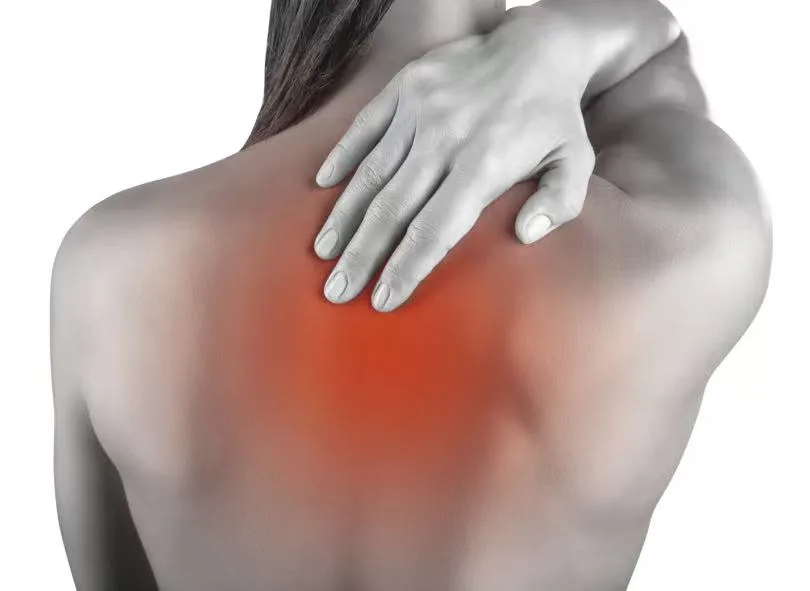
What's really going on?
Interscapular pain can come from joint stiffness in the mid-back, overworked muscles, poor posture, or issues in the neck. But emotional stress is often an overlooked piece of the puzzle — and understanding it can make a real difference to how you manage the pain.
1. Stress puts your muscles on alert
When you're stressed, your body switches on its "fight-or-flight" response. Your heart rate rises, your breathing quickens, and your muscles tense up — ready for action. That's fine for a short burst of stress. But when stress lingers for weeks or months, your muscles can stay tense the whole time.
The muscles around your neck, shoulders, and upper back are especially prone to this. Many people unconsciously hunch their shoulders or hold their shoulder blades stiffly when under pressure — and over time, that constant low-level tension leads to soreness and fatigue between the shoulder blades.
2. It's not just one "tight" muscle
Muscles like the trapezius, rhomboids, and the muscles that stabilise your shoulder blade all work together. Under prolonged stress and long hours of sitting, your whole upper body can lose its normal variety of movement.
A healthy back moves constantly throughout the day — reaching, turning, breathing, walking. When stress and sitting still reduce that movement, the same tissues get loaded again and again, which can feel like a deep, nagging ache by late afternoon.
3. Breathing plays a bigger role than you'd think
Stress often changes how we breathe — faster, shallower, and more from the chest instead of the diaphragm. This pulls in extra neck and shoulder muscles to help you breathe, adding even more tension around the upper back.
Because breathing also involves movement of the ribs and mid-back, stiffness in this area can make the problem worse. Learning to breathe more efficiently is often a genuinely useful part of treatment.
4. Stress can turn up your pain "volume"
Pain isn't just about tissue damage — it's processed by your nervous system, which is influenced by stress, sleep, past experiences, and how much attention you're paying to the area. That's why two people can do the exact same physical activity and feel very different levels of discomfort.
Under ongoing stress, your nervous system can become more sensitive, making normally harmless signals feel more painful than they should.
5. The stress–pain cycle
Left unchecked, stress and pain can feed each other:
- Stress increases muscle tension
- Muscle tension causes discomfort
- Discomfort disrupts sleep and reduces activity
- Poor sleep and less movement increase fatigue and stress
- Higher stress increases tension and pain sensitivity again
This is why treating the sore muscles alone sometimes gives only temporary relief — if the stress, sleep, and movement habits behind it don't change, the pain tends to come back.
6. Movement matters more than "perfect posture"
Sitting for long stretches increases the load on your neck and mid-back — but posture alone isn't usually the whole story. The bigger issue is often a lack of movement variety throughout the day.
Simple habits help: changing position regularly, rotating your trunk, moving your shoulder blades, and taking short breaks to walk. Useful exercises often include thoracic mobility work, wall slides, rowing movements, and scapular control exercises — tailored to what you can manage.
7. "It's stress-related" doesn't mean "it's not real"
It can be frustrating to hear that stress might be contributing to your pain — it's easy to feel like you're being told the pain isn't real. That's not the case. Emotional stress and physical pain aren't separate systems; they're connected through your nervous system, muscles, and hormones.
Recognising stress as a factor doesn't dismiss your pain — it simply gives your treatment plan another angle to work with.
How we can help
A combined approach tends to work best for stress-related interscapular pain:
- Manual therapy to ease pain and restore movement
- Exercise therapy to build thoracic mobility, scapular control, and strength
- Breathing exercises to reduce unnecessary tension in the neck and chest
- Stress management — better sleep, regular activity, and relaxation techniques
- Acupuncture, which may help some people as part of a broader pain-management plan
If your pain is persistent or unexplained, it's always worth getting it properly assessed to rule out other causes before assuming it's stress-related.
Pain between your shoulder blades doesn't have to be something you just live with. If it's been bothering you, we can help you get to the bottom of it and build a plan that works for your body and your life. Book an assessment.

Midtown Wellness
ACC-accredited clinic in Auckland CBD providing massage, acupuncture and physiotherapy. The hands with knowledge are powerful.