An easy-to-understand guide for patients.
If you get migraines, you have probably noticed that your neck is involved too — a stiff, achy band at the base of your skull that shows up before an attack, during it, or both. Many people assume this means their neck is "causing" the migraine. The truth is more interesting, and more useful.
Migraine is a neurological condition. But the nerves of your upper neck and the nerves that carry pain from your head and face share the same wiring in the brainstem. That shared wiring is why neck tension and headache so often travel together — and why treating the neck can help some people, even though it is not a cure for migraine itself.
Meet the Suboccipital Muscles
Tucked deep under the base of your skull, at the very top of your neck, is a small group of four paired muscles:
- Rectus capitis posterior major
- Rectus capitis posterior minor
- Obliquus capitis superior
- Obliquus capitis inferior
Together they are called the suboccipital muscles. They are tiny — each about the size of your thumb — and they handle the fine adjustments of your head: the small nods, tilts, and turns that keep your eyes level while the rest of you moves.
Here is what makes them special. For their size, they are packed with an extraordinary number of sensory receptors — the tiny detectors that tell your brain exactly where your head is in space. They are less like brute-force movers and more like a precision instrument constantly reporting back to your nervous system.
That is exactly why they matter for headache. When these muscles are overloaded, fatigued, or irritated, they do not just ache — they send a distorted stream of sensory information into a part of the nervous system that also handles head pain.
The Neck–Headache Connection Explained
The link has a name: the trigeminocervical complex.
The trigeminal nerve carries sensation from your face, forehead, and much of your head. The top three nerves of your neck carry sensation from your upper cervical spine. In the brainstem and upper spinal cord, these two systems converge — they feed into shared pathways.
Because the wiring overlaps, your brain cannot always tell precisely where a signal came from. Irritation arising in the upper neck can be experienced as pain in the head. And in someone whose nervous system is already sensitised — as it is in migraine — that extra input can add to, or amplify, the pain of an attack.
An important caveat: tight neck muscles do not cause migraine. Migraine has genetic, hormonal, environmental, and neurological drivers that have nothing to do with your posture. But for some people, neck tension acts as a trigger, an aggravating factor, or a companion symptom — and that part is often treatable.
Neck Pain During an Attack: Cause or Symptom?
This is one of the most misunderstood parts of migraine, so it is worth being clear.
Neck pain is extremely common in migraine. Some people feel their neck tighten hours before the headache arrives. Others develop neck pain once the attack is underway. It is tempting to conclude the neck started it — but often the neck symptoms are part of the migraine attack itself, generated by the same sensitised pathways producing the head pain.
Why does the distinction matter? Because it changes what helps:
| If your neck symptoms are… | Then… |
|---|---|
| Part of the migraine attack | Hands-on treatment may ease the discomfort, but migraine-specific medical management is the main event. |
| A genuine neck problem alongside migraine | Treating stiffness, muscle tension, and movement restriction can meaningfully reduce your total pain load. |
| Both at once (very common) | A combined approach usually works best — medical migraine care plus musculoskeletal treatment. |
A good assessment is what tells these apart.
What Loads Up Your Upper Neck
Several everyday factors increase the mechanical and sensory stress on your upper cervical spine and the muscles around it:
- Long stretches of computer work without breaks
- Forward-head posture — your head drifting ahead of your shoulders
- Extended periods looking down at a phone
- Awkward sleeping positions or an unsuitable pillow
- Repetitive work, particularly with the arms unsupported
- Previous neck injury, including whiplash
- Ongoing stress, fatigue, and poor sleep
When your head sits forward of your trunk, the muscles at the back of your neck must work continuously just to hold it up. The suboccipital muscles, whose job is fine positional control rather than heavy lifting, are poorly suited to that kind of sustained load — and they fatigue.
That said, posture is not a simple villain. People with all sorts of postures get migraines, and sitting up straighter will not, on its own, make migraine disappear. The realistic way to think about it: sustained positions add stress to an already susceptible system. Reducing that stress removes one contributor, not the whole condition.
Trigger Points and Referred Pain
Muscles in the upper neck can develop small, exquisitely tender spots that clinicians call trigger points. Press on one and the pain does not stay put — it spreads, often to somewhere surprising.
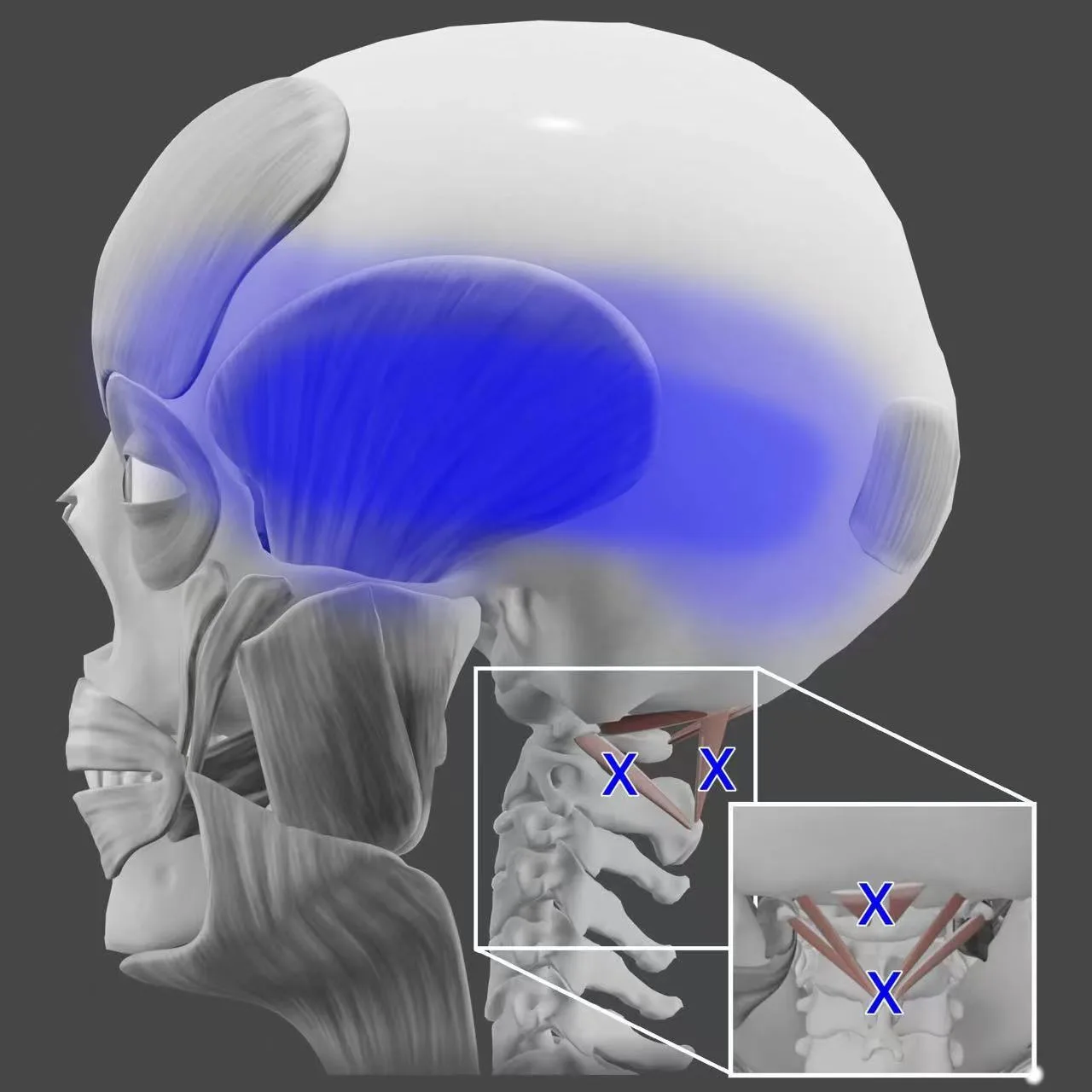
Tenderness in the suboccipital region commonly refers pain toward the back of the head, the temples, the forehead, or around and behind the eye. Other neck muscles have their own referral patterns and can contribute too:
- Upper trapezius — up the side of the neck toward the temple
- Sternocleidomastoid — into the forehead, behind the eye, and around the ear
- Splenius muscles — to the top of the head and behind the eye
- Levator scapulae — along the angle of the neck and shoulder
Because these patterns overlap so closely with where migraine pain is felt, muscular referred pain and migraine are easy to confuse. Many people have both — and each one influences how bad the overall experience is.
Can Physiotherapy and Manual Therapy Help?
If you have real neck stiffness or muscular tenderness alongside your migraines, hands-on treatment is worth considering as part of a broader plan. Treatment may include:
- Gentle soft-tissue techniques for the neck and upper back
- Cervical mobility work to restore comfortable movement
- Thoracic (upper back) mobility — often the real source of neck overload
- Strengthening the deep neck muscles that support your head properly
- Posture and workstation education
- Relaxation, breathing, and stress-management strategies
Be wary of anyone promising to "cure" your migraine by releasing one muscle. That is not how this works. The realistic goal is to reduce the musculoskeletal contributors, improve how your neck moves, and give you tools to manage the symptoms that travel with your headaches.
Treatment around the upper neck should always be gentle and preceded by a proper assessment — particularly if your headaches are unusual, severe, or changing.
What About Acupuncture?
Acupuncture is another option that many people with migraine find useful.
From a biomedical perspective, acupuncture appears to influence pain-processing pathways and the nervous system. Clinical evidence suggests it can reduce migraine frequency for some people when it forms part of an appropriate treatment plan. From a traditional Chinese medicine perspective, migraine is associated with several different underlying patterns, and treatment is tailored to your individual presentation rather than applied from a fixed recipe.
When neck muscle tension is present as well, treatment can address both the headache pattern and the cervical muscular symptoms in the same session.
One caution: acupuncture is not a substitute for medical assessment when a headache is new, unusual, or concerning in any way.
What a Thorough Assessment Looks Like
When migraine and neck pain occur together, looking at one structure in isolation rarely gives the full picture. A comprehensive assessment considers:
- Your headache characteristics, frequency, and pattern
- Neck range of motion, and upper cervical mobility specifically
- Suboccipital muscle tenderness
- Upper trapezius and sternocleidomastoid tension
- Posture and movement habits
- Sleep quality and position
- Stress levels
- Work setup and screen habits
- Any history of neck injury
From there, treatment is matched to what is actually driving your symptoms. For some people the priority is migraine-specific medical management. For others, reducing neck tension, restoring movement, managing stress, and reshaping daily habits delivers the bigger win. For many, it is both.
When to Get Checked Medically
Migraine is common — but not every headache is a migraine. Please seek prompt medical assessment if a headache:
- Comes on suddenly and is extremely severe
- Follows a significant head or neck injury
- Comes with neurological symptoms — weakness, numbness, slurred speech, unsteadiness, or vision changes
- Comes with fever, confusion, fainting, or persistent vomiting
- Is clearly different from your usual headache pattern
A new or substantially changed headache should never simply be put down to neck tension or tight muscles.
The Takeaway
Migraine is a neurological condition — and your neck is genuinely part of the story. Tight suboccipital muscles do not cause migraine, but the sensory traffic from your upper neck feeds into the same pathways that produce head pain, and for many people that connection makes attacks worse or more frequent.
The practical upshot is encouraging: while you cannot change the neurology you were born with, you can change how much stress your neck adds on top of it. Better movement, less muscle tension, a smarter workstation, decent sleep, and lower stress all reduce the load — and for many people that means fewer and less intense attacks.
If migraine and neck pain are affecting your days, a careful assessment can identify which factors are contributing to your symptoms and guide a safe, personalised plan. Book an assessment with us and let us help you get on top of it.

Midtown Wellness
ACC-accredited clinic in Auckland CBD providing massage, acupuncture and physiotherapy. The hands with knowledge are powerful.