An easy-to-understand guide for patients.
A dull ache, a throbbing, or a band of tightness at the back of your skull is one of the most common complaints we see. Most of the time it is harmless and passes on its own — but when it keeps coming back, it can really wear you down. This guide explains what causes pain at the back of the head, why a small group of muscles at the base of your skull is so often to blame, and the simple steps that can help.
What Does Posterior Head Pain Feel Like?
"Posterior head pain" simply means pain felt at the back of the head, over the occipital region (the lower-back part of the skull). People describe it in different ways:
- A dull, deep ache or a feeling of pressure
- A tight band or "heavy head" sensation
- Occasional sharp, shooting, or electric-shock-like jolts that travel up toward the top of the head
- Tenderness of the scalp, or pain that spreads toward the eyes or temples
It often shows up alongside a stiff, achy neck — and that is a big clue to where it comes from.
The Common Causes
Pain at the back of the head can come from several sources. In modern desk-based life, by far the most common are muscle and posture related.
| Type of cause | What it involves |
|---|---|
| Muscle & neck strain (most common) | Forward head posture from computer and phone use overloads the neck muscles, creating fatigue and tender "trigger points" that refer pain to the back of the head. |
| Nerve-related pain | Irritation of the greater occipital nerve (occipital neuralgia) or tension-type and cervicogenic (neck-driven) headaches. |
| Everyday triggers | Eye strain from screens, poor sleep or an unsuitable pillow, and stress can all raise muscle tension and lower your pain threshold. |
| Less common medical causes | Occasionally, raised blood pressure or reduced blood flow through the neck arteries. Rarely, more serious conditions — see the red-flag list below. |
The Key Players: Your Suboccipital Muscles
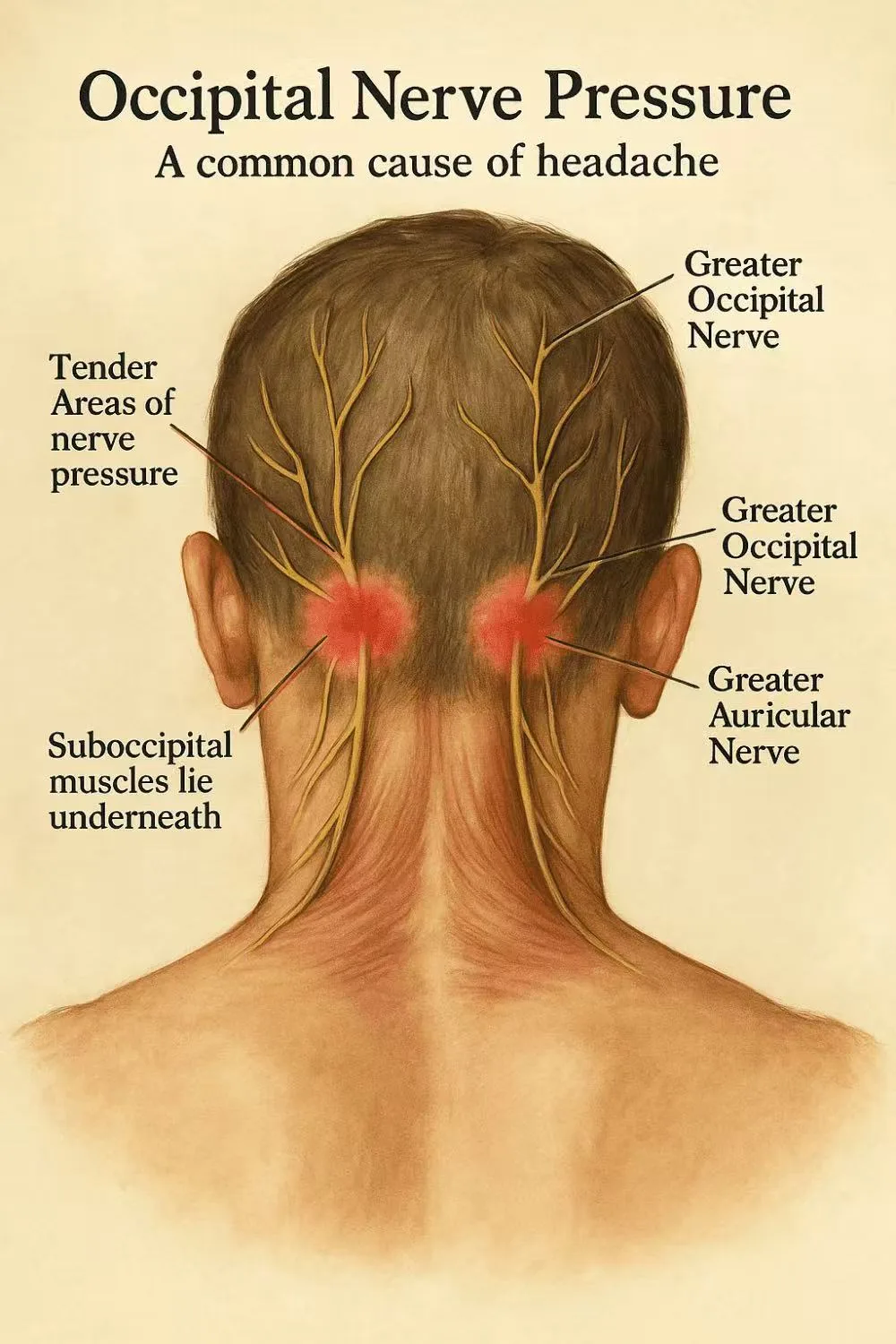
Tucked deep at the junction of your skull and neck are four small paired muscles known as the suboccipital muscles. They are tiny, but they do a big job — they make the constant fine adjustments that keep your head balanced and your eyes level. Here is why they matter so much for headaches:
1. They carry the weight of "text neck"
When your head drifts forward — looking down at a phone or leaning toward a screen — the load on your neck muscles climbs dramatically. Every couple of centimetres of forward drift adds roughly 4–5 kg of extra strain. The suboccipital muscles hold that position hour after hour, and over time they become fatigued, tight, and full of tender knots.
2. They sit right next to an important nerve
The greater occipital nerve, which supplies feeling to the back and top of the scalp, passes directly through this region. When the suboccipital muscles become tight or spastic, they can squeeze and irritate this nerve — turning local muscle ache into radiating, shooting head pain.
3. They are linked to your eyes
These muscles are packed with an extraordinary density of position sensors — many times more than most muscles in the body — and they work closely with your eye-movement system to keep your vision steady. Long stretches of staring at a fixed screen reduce your natural eye movement, which quietly keeps these muscles switched "on" and tense, even when your neck is not moving. It becomes a self-feeding loop of tension and pain.
Symptoms That Often Come Together
Posterior head pain rarely travels alone. You may also notice:
- Neck stiffness — a reduced range of motion and tender, ropey muscles you can feel with your fingertips
- Dizziness or a "heavy head", and sometimes blurred vision
- Pressure behind the eyes, sensitivity to light or sound, or a tender scalp
- A morning pattern — worse on waking, easing as the day goes on, often pointing to sleep position or pillow height
A Simple Self-Check
Using your index and middle fingers, gently feel along the groove at the base of your skull, roughly 2 cm out to each side from the bump in the centre. Press firmly but comfortably. If this reproduces your usual headache — or sends a spread of discomfort toward your forehead or eyes — it is a strong sign that your suboccipital muscles are a main source of the pain.
What You Can Do for Relief

Set up your workspace
- Screen height: the top of your monitor at or just below eye level, so you look slightly down (about 15–20°) without dropping your chin.
- Chair and desk: feet flat on the floor, thighs level, elbows around 90°, and forearms supported.
- Avoid neck-cradling the phone: use a headset or speaker instead of pinning it between ear and shoulder.
Gentle exercises
- Chin tucks: gently glide your head straight back to make a "double chin" (not tilting up or down). Hold a few seconds. This lengthens the suboccipital muscles and wakes up the deep neck muscles that support good posture.
- Easy neck mobility: slow, pain-free turns and side tilts to keep the joints moving — never force the end of the range.
- Open the chest, work the upper back: stretch the front of the chest and gently strengthen the muscles between the shoulder blades to undo the rounded-forward posture.
Always move gently and stop if anything sharply hurts.
Rest your eyes — the 20-20-20 rule
Every 20 minutes of screen time, look at something at least 20 feet (6 metres) away for 20 seconds. This relaxes both your eyes and, through their close connection, the suboccipital muscles.
Sleep well
- On your back: a pillow that, when compressed, is about the height of your fist supports the natural curve of your neck.
- On your side: the compressed pillow should fill the gap to the width of your shoulder, keeping the neck level and straight.
- Avoid sleeping face-down — it forces your neck into a long, twisted position all night.
When to See a Professional
If your pain is persistent, keeps returning, or is not improving with these steps, a hands-on assessment can identify exactly which muscles and joints are involved and treat them directly. A combination of manual therapy, targeted exercise, and posture correction is often highly effective.
Please seek prompt medical attention, however, if your headache comes with any of these red flags:
- A sudden, severe "thunderclap" headache that peaks within seconds to minutes
- Headache that steadily worsens over days despite rest and simple measures
- Fever, a stiff neck, confusion, or drowsiness
- Weakness, slurred speech, unsteadiness, or changes in your vision
- A recent head or neck injury
The Takeaway
For most people who spend their days at a screen, pain at the back of the head is not a mystery — it is the predictable result of forward head posture, tired suboccipital muscles, and long hours of fixed focus. Understanding that connection is empowering, because it means small, consistent changes to your posture, workspace, eye habits, and sleep can genuinely reduce how often and how hard these headaches hit.
If posterior head pain is affecting your day, you do not have to just live with it. Book an assessment with us and let us help you find the source of your pain and a plan to relieve it.

Midtown Wellness
ACC-accredited clinic in Auckland CBD providing massage, acupuncture and physiotherapy. The hands with knowledge are powerful.